For adults learning Hashi bridges puzzles: tell us where you get stuck, get the one technique that fixes it.
Where do you get stuck?
Tap the one that sounds like you. Each answer is a technique you can test on the 9-island board below.
Free on iPhone
By the Honest Little Apps studio · Updated November 2026 · We make Sumbriska, a sum-based bridge puzzle; these tips are for classic Hashi.
The short answer
How do you solve a bridges puzzle?
Solve a bridges puzzle by placing only bridges you can prove. Start with islands that have one neighbor or whose number is twice their neighbor count, then treat full islands as walls and recount. Finish by checking that every island joins one network. Never guess; every fair Hashi has a logical next step.
The rules, as Nikoli, the Japanese publisher that named the puzzle, lists them:
Connect islands with as many bridges as the number on the island.
No more than two bridges between any two islands.
Bridges run straight, and cannot cross islands or other bridges.
All the bridges must join every island into one connected group.
Every bridge you draw should come with a reason you could say out loud.
Try it
A 9-island board with a hint that explains itself
Tap the dotted line between two islands to add a bridge; tap again for a double, once more to clear it. Islands turn green when full. Stuck? Press Next step and the board places one proven bridge and tells you why.
Start with the corner 2 at the top left. How many neighbors can it see?
We generated this board and checked by computer that it has exactly one solution.
Cheat sheet
Bridges puzzle techniques by number
One rule covers most openings: an island showing n with k neighbors must send at least n − 2(k − 1) bridges to every neighbor.
Expert solvers on 25×25 grids: you need chain and parity reasoning, not openings.
Anyone who wants pure Hashi on iPhone: Sumbriska changes the rule, so pick a classic Hashi app. We compare a few in games like Hashi bridges.
Speed-runners: this page is about careful logic, not timers.
Method
Hashi strategy in three passes
Opening pass. Sweep the grid once for forced islands: one neighbor, a corner 4, an edge 6, any 8, and every 3, 5 or 7 that has the fewest neighbors it could have. Place only what the table proves.
Wall pass. Each full island blocks the way for its neighbors. Recount neighbors for every unfinished island and repeat the table. Most mid-game "stuck" feelings disappear here.
Connection pass. Before you join two islands, ask whether that closes off a group. Two 1s should never join each other, and two 2s should not double-link, unless that finishes the whole puzzle.
Most mid-board jams end the moment you count a full island as a wall.
Same habits, new bridge
Where Sumbriska fits
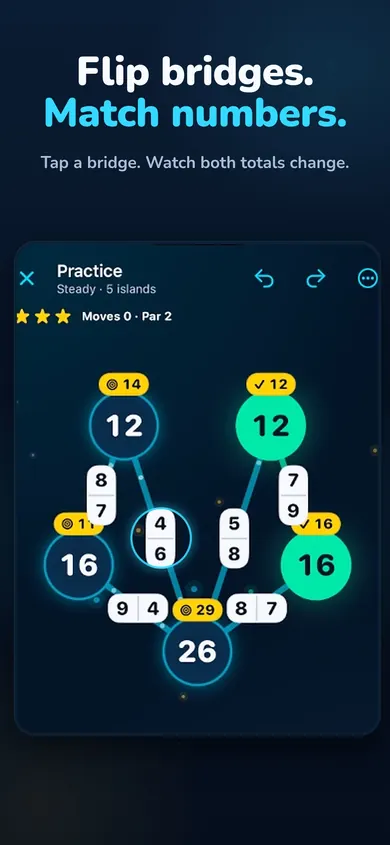
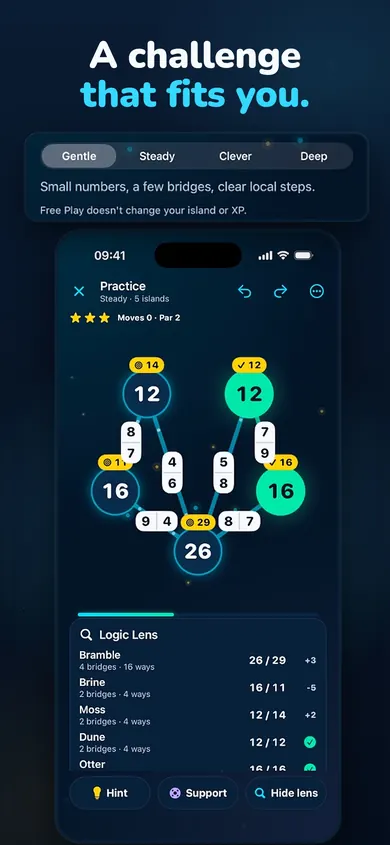
In Sumbriska each island shows a target number, and every bridge carries two numbers, one for each end. Flipping a bridge changes both islands' totals, and you win when every sum lands exactly. Counting, treating finished islands as walls and refusing to guess carry over directly.
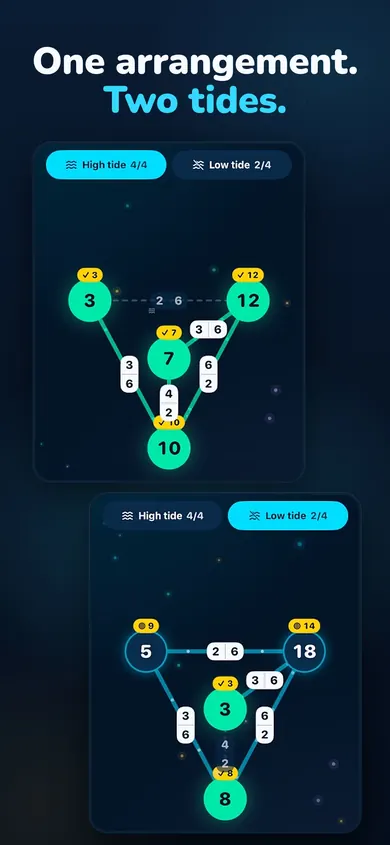
FLIPTap a bridge; both totals change.TWO TIDESOne layout, two tide schedules.HINTS FREEHints never cost XP.
One design decision we stand by: hints, Undo and step explanations are always there and never cost XP, because the point is learning the logic. The honest limit: the free download includes regions 1 and 2, the Daily board, The Deep and Harbor Run; regions 3 to 6 and the side boards need the optional Voyage Pass ($4.99 a month or $29.99 a year, no free trial).
Side by side
Classic Hashi vs Sumbriska, in four lines
Classic Hashi
Count bridges: an island's number is how many bridges touch it.
Sumbriska
Balance sums: each flip sends numbers to both ends of a bridge.
Classic Hashi
Hard part: crossings and keeping one connected network.
Sumbriska
Hard part: one flip moves two totals; Two Tides boards must solve twice.
Like counting? Stay classic. Like arithmetic and a harbor that grows as you solve? Try Sumbriska tonight.
Flip bridges. Match numbers.
A quiet, clever number puzzle with a Daily board, no ads, no accounts, and full offline play. Try it tonight.
Free on iPhone
More from Pocket Puzzle Arcade
Games like Hashi bridgesLove Hashi bridge puzzles? Three honest iPhone picks compared from their App Store listings, a 3-tap matcher, and a playable flip-the-bridge board.
Number puzzle of the dayA free number puzzle of the day: flip bridges until every island hits its sum. New board at midnight, par to beat, last 7 days playable.
When to prestige in idle gamesWhen should you prestige in an idle game? Slide in the bonus a reset would give you, see NOW vs AFTER, and get a clear reset-or-push verdict.
How to get better at endless runner gamesHow to get better at endless runner games: sort the fixes by impact, test your flip timing in a 5-round trainer, and practise in short, rested sessions.