What is the difference between primary and secondary sources?
A primary source was made at the time you are studying, by someone who was there or close to it. A secondary source looks back and explains, retells or interprets those events later. So the test is not "what kind of thing is it?" but "when, and by whom, was it made, compared with the event?"
The Library of Congress puts it well in its guide for teachers: primary sources are "the raw materials of history — original documents and objects that were created at the time under study", while secondary sources are "accounts that retell, analyze, or interpret events, usually at a distance of time or place."
Primary means made then. Secondary means made later, about then.
Those four stickers are the labels PastRush puts on every exhibit. They split the old two-way sort into something closer to how historians actually think, because "written later" by an eyewitness is not the same as a modern reconstruction.
Primary and secondary source examples: 12 real cases
Here is a sorted list using real objects and texts. Read the "why" column; it matters more than the label.
| Source | Type | Why |
|---|---|---|
| The Rosetta Stone, carved 196 BC | Primary | Made during Ptolemy V's reign, per the British Museum |
| Champollion's 1822 paper on hieroglyphs | Secondary | About the stone; written 2,000+ years later |
| A soldier's diary from 1916 | Primary | Written during the war by a participant |
| A 2020 book about the Battle of the Somme | Secondary | Interprets the battle a century later |
| Pliny the Younger's letter on Vesuvius | Primary | Eyewitness account, though written years after AD 79 |
| A photograph of a 1963 march | Primary | Captured at the moment |
| A documentary about that march | Secondary | Edits and explains later; may contain primary clips |
| A newspaper report the day after an event | Primary | Made at the time, though not always by a witness |
| A newspaper anniversary feature 50 years on | Secondary | Looks back and interprets |
| Coins found in a Roman house | Primary | Objects from the period itself |
| Your history textbook | Tertiary | Summarises secondary sources |
| An encyclopedia entry | Tertiary | A summary of summaries; good for a start, not as evidence |
The label depends on the question you're asking, not the shelf the source sits on.
Who should use something else
We want this page to be useful even if you never download anything.
- University researchers working with archives need a proper citation guide and a librarian, not a game.
- Students writing a source-analysis essay tonight should start with the 12 examples above and their teacher's own definitions. Rules vary slightly by school.
- Younger children (under 9): PastRush is rated 9+ on the App Store, and the reading level fits that.
If you need it for a paper due tomorrow, the table above is faster than any app.
Honest limits of PastRush
- Half the cases cost money. Six investigations are free: the Rosetta Stone, Pompeii, the Grand Canyon's rock layers, Ötzi the Iceman, continental drift and the Norse in Vinland. Six more need Founder Lifetime, a one-time purchase with no subscription.
- Story pictures are illustrations. They are AI-assisted and labelled as illustrations, never presented as photographs of real objects. We think that labelling is the honest choice, and it is a good talking point about evidence in itself.
- Some features need internet. The satellite map, Dive's satellite views and Where in the World? need a connection; the cases, Notebook and Album work offline.
One design decision we stand behind: every answer explains why and links to the source behind it, so a wrong answer still teaches something.
Six free cases are a full afternoon of evidence work; the other six are optional.
How PastRush practises source skills
The app's Source comparison challenge asks what each source supports, and what neither shows. Here it is with the real Rosetta Stone case. Hover or tap a screenshot to see it in full colour.
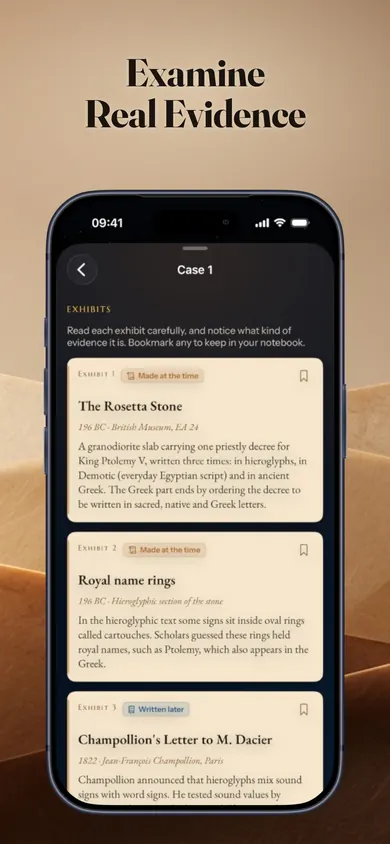
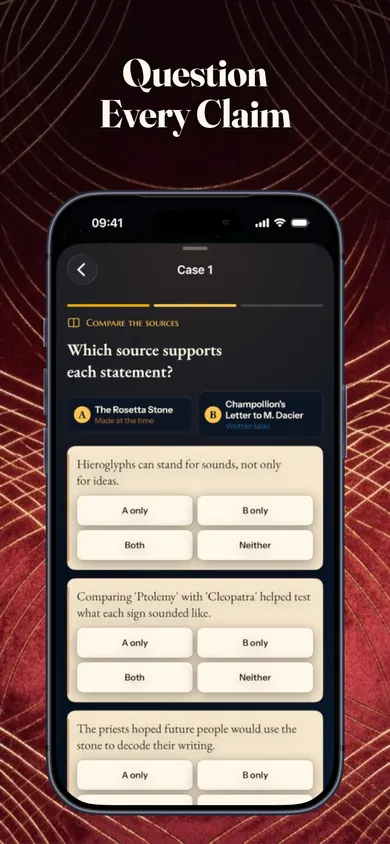
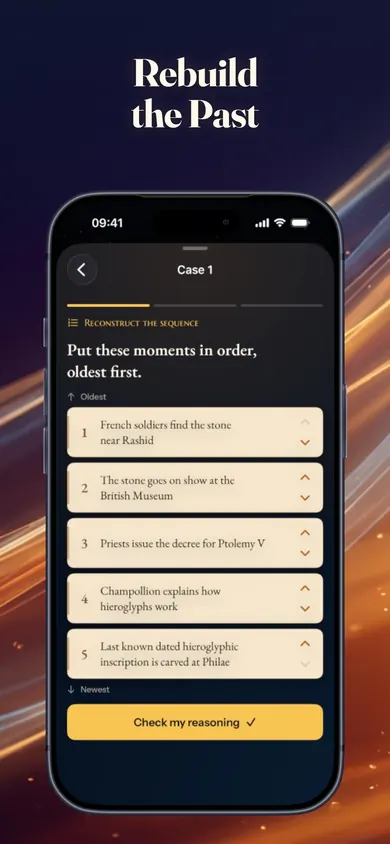
There is also a Daily Evidence Check: five claims to judge each day. That is the habit this page is really about, a few minutes of asking "how do we know?"
Five claims a day is enough to make "how do we know?" automatic.