BC to AD math, minus the off-by-one.
For parents checking timeline homework. Type two years, pick BC or AD, and get the real gap.
7:40 pm · the kitchen table
The homework question that trips everyone up
The worksheet says the Rosetta Stone decree was carved in 196 BC and that Jean-François Champollion announced he could read it in 1822. Question 4: how many years apart? Your child writes 2,018. You check it, nod, and you are both wrong by one.
Adding the two numbers feels right, and it nearly is. The catch is that the calendar jumps straight from 1 BC to AD 1. There is no year zero to cross, so simple addition counts one year that never existed. The real answer is 2,017. That is what the calculator above shows on its first load.
Crossing from BC into AD? Add the two years, then take away one.
The rule
How do you calculate years between BC and AD?
Add the BC year to the AD year, then subtract 1, because the calendar has no year 0. From 196 BC to AD 1822 is 196 + 1822 − 1 = 2,017 years. If both dates are BC, or both are AD, just subtract the smaller number from the larger one. No adjustment is needed.
| Your two dates | What to do | Example |
|---|---|---|
| One BC, one AD | BC + AD − 1 | 196 BC → 1822: 2,017 |
| Both AD | Larger − smaller | 1021 → 2026: 1,005 |
| Both BC | Larger − smaller | 500 BC → 196 BC: 304 |
| 1 BC and AD 1 | 1 + 1 − 1 | 1 year, not 2 |
Astronomers sidestep the problem by writing years as plain numbers with a year 0. NASA's eclipse site explains that in this "astronomical" numbering, year 0 is 1 BCE and −1 is 2 BCE, so any BCE year x becomes −(x − 1). Our calculator does exactly that behind the scenes, then subtracts.
The calculator converts BC to astronomical years first, so the off-by-one cannot sneak in.
Before you download anything
Who should use something else
If you only need the arithmetic, the calculator on this page is the whole job, and you are welcome to bookmark it. PastRush is a game about evidence, not a date converter.
- Kids under 9: PastRush is rated 9+ on the App Store, and its cases ask for real reading.
- Fast trivia fans: if you want quick-fire "which came first" rounds and nothing else, a card game like Timeline or a daily trivia app will feel lighter.
- Exact day counts: neither this calculator nor the app counts days or months. Both work in whole calendar years.
Need only the number? This page is enough. Need the habit of checking evidence? That is what the app is for.
Inside the app
Chronology practice for kids, with real case files
PastRush turns date order into a detective job. In its Chronology challenges you rebuild the order of events, and the listing says BC/AD dates are "handled correctly". Six investigations are free for everyone: the Rosetta Stone, Pompeii, the rock layers of the Grand Canyon, Ötzi the Iceman, continental drift and the Norse in Vinland.
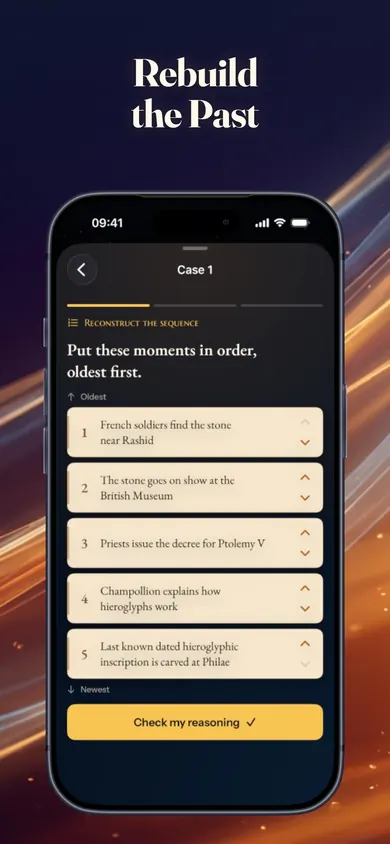
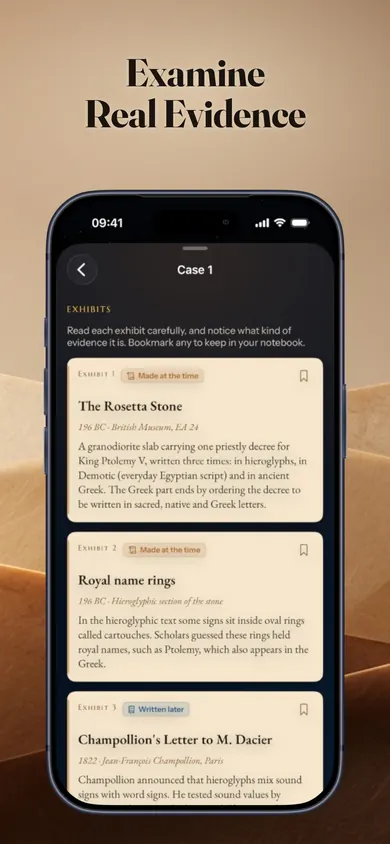
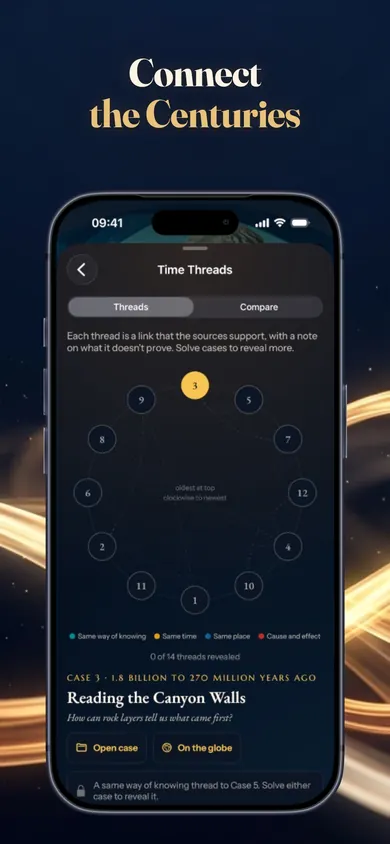
A true-scale time bar shows how far apart two events really are, which is the same idea as the gold bar under our calculator. Every answer explains why and links to the source behind it.
Six of the twelve cases are free, with no account and no ads.
Worked examples
BC to AD timeline examples you can check
Here are three gaps from cases in the app, each with a published date. Tap the matching chip under the calculator and the numbers should agree.
- Rosetta decree to discovery: 1,994 years, not 1,995. Live Science's history column dates the decree to 196 BC and the stone's discovery to 1799. So 196 + 1799 − 1 = 1,994 years.
- Decree to decipherment: 2,017 years. The same article dates Champollion's announcement to 27 September 1822.
- Norse wood-cutting to today: 1,005 years. A 2021 study in Nature, summarised by the University of Groningen, used a solar-storm signal in tree rings to date woodworking at L'Anse aux Meadows to AD 1021. Both dates are AD, so 2026 − 1021 = 1,005.
Honest limit: many ancient dates are approximate. A gap between two "about" dates is only as exact as the dates themselves, so write "about 2,000 years" when your source says "about".
A precise answer from fuzzy dates is still fuzzy. Say "about" when the source does.
Three ways to count
How many years from 1 BC to AD 1?
One. That tiny case is the best test of any method, so here is how the common approaches score on it and on our Rosetta example.
| Method | 1 BC → AD 1 | 196 BC → 1822 |
|---|---|---|
| Just add the numbers | 2 (wrong) | 2,018 (wrong) |
| Add, then subtract 1 | 1 | 2,017 |
| Astronomical years (0 = 1 BC) | 1 − 0 = 1 | 1822 − (−195) = 2,017 |
We built the calculator on the third method because it never needs a special case, even for two BC dates. The design choice in PastRush is similar: in its Which Came First? rounds, dates that historians still debate are left out, so every round has one right answer.
Test any method with 1 BC to AD 1. If it says 2, it is counting a year that never happened.
Quick answers
BC and AD questions parents ask
Is there a year 0 between BC and AD?
No. The calendar goes straight from 1 BC to AD 1. Astronomers add a year 0 (equal to 1 BC) to make calculations easier, but historians' BC and AD dates have no year 0.
How many years ago was 500 BC?
In 2026, 500 BC was 2,525 years ago: 500 + 2026 − 1. Type 500 BC and 2026 AD into the calculator to check.
Do BCE and CE work the same way as BC and AD?
Yes. BCE and CE use the same year numbers as BC and AD, so the same rule applies: add the two years and subtract 1 when you cross from BCE into CE.
How do I count centuries with BC dates?
The 1st century BC runs from 100 BC to 1 BC, and the 1st century AD runs from AD 1 to AD 100. Because there is no year 0, each century starts with a year ending in 1 on the AD side.
Does PastRush teach BC and AD dates?
Its Chronology challenges ask you to rebuild the order of events, and the App Store listing says BC/AD dates are handled correctly. The app also has a true-scale time bar that shows how far apart two events are.
Is PastRush free?
Yes, it is free to download. Six investigations are free for everyone. Six more, every story collection on the globe and the Master tier come with Founder Lifetime, an optional one-time purchase.

Turn date math into detective work
PastRush: History Detective has 12 investigations, a Daily Evidence Check and a true-scale time bar. Download free on the App Store; the optional Founder Lifetime is a one-time purchase.
More from Pocket Puzzle Arcade
- Primary vs secondary sources examplesPrimary vs secondary sources, with 12 real examples, a 3-tap quiz and straight answers to the questions students and parents ask most.
- Idle game upgrade payback calculatorWhich idle game upgrade should you buy next? Compare cost and income, see payback time and the best next buy, then test yourself in a 3-round quiz.
- Games like Gravity GuyGravity Guy left the App Store in 2018. Play a 20-second gravity-flip demo, then compare three current one-tap runners from their App Store listings.
- How to teach number bonds to 10Number bonds to 10 not sticking? Tick a 5-step checklist to find where to start, try no-prep games, and play a make-10 demo with your child.