How do you teach number bonds to 10 at home?
Teach number bonds to 10 in order: real objects first, then a ten frame or fingers, then hidden parts, then quick recall, and only then adding across ten. Most "it won't stick" moments happen because a child was asked for step 4 while still living at step 2. Five calm minutes a day beats one long session.
That order is not our invention. The US Institute of Education Sciences' 2013 practice guide, Teaching Math to Young Children, makes its first recommendation "Teach number and operations using a developmental progression", and rates the evidence for it as moderate. The checklist above is that idea applied to one small topic.
If a bond won't stick, step back one stage, not forward.
The five stages, with one no-prep game each
- Count ten things. Touch-and-count 10 pasta shapes, then ask "how many?" again without recounting. Game: Shoe line. Line up 10 shoes by the door, one touch per shoe.
- See ten as two parts. Use an egg box cut to 10 cups, or two hands. Put 6 in; how many empty cups? Game: Finger flash. Show 7 fingers; your child shows the rest.
- Find the hidden part. Ten coins on the table, cover some with a cup. "I can see 4. How many are hiding?" Game: Cup trick. Swap roles so your child hides and you guess, sometimes wrongly on purpose.
- Know the pairs as facts. 1 and 9, 2 and 8, 3 and 7, 4 and 6, 5 and 5, both ways round, plus the matching take-away (10 − 3 = 7). Game: Ten snap. Deal number cards 1–9 and snap any two that make 10.
- Use ten as a bridge. 8 + 5 becomes 8 + 2 (that's 10) + 3. Game: Make ten first. Say a sum near the car or the table and race to say the "make ten" step out loud.
Stage 5 is the payoff: a child who owns ten can add 8 + 5 without counting on fingers.
Try the bridge idea together: a 20-second Bond Lab
This is the core move of Number Beasts, cut down to one beast. Tap a number to launch it. Make exactly 10 and the beast pops. Fall short and it grows, so now it needs a smaller number. Overshoot and it pops, but the leftover spills back in as a new beast. Ask your child to say the sum out loud before each tap.
Needs 4 to make 10
Pick a number. Which one makes exactly 10?
Notice what overshooting teaches. Launch a 7 into a 5 and you get "5 + 5 is 10, with 2 left over". That spoken sentence is stage 5 hiding inside a game. You can also play it with no screen at all, using two piles of coins.
The leftover is the lesson: 7 into 5 is ten, plus 2.
What age should a child know number bonds to 10?
Expectations differ by country, so here is what two official curricula say, checked November 2026:
| Curriculum | Year | What it asks |
|---|---|---|
| US Common Core, K.OA.A.4 | Kindergarten | For any number from 1 to 9, find the number that makes 10, using objects or drawings |
| US Common Core, 1.OA.C.6 | Grade 1 | Add and subtract within 20, with fluency within 10; "making ten" is one named strategy |
| England National Curriculum, Year 1 | Ages 5–6 | Represent and use number bonds and related subtraction facts within 20 |
So in the US, finding the partner with objects is a kindergarten goal and quick recall is a first-grade one. Plenty of children get there later, and that is fine; the standards describe the end of a school year, not a deadline at home.
Kindergarten: find the partner with objects. Grade 1: know it quickly.
Number bonds to 10: parent questions
What are number bonds to 10?
Is it OK if my child counts on their fingers?
How long should we practise each day?
My child knows the pairs at home but freezes at school. Why?
Is Number Beasts free, and does it have ads?
What age is Number Beasts for?
Who should pick something else
- Children still learning to count to 10. Stay with real objects (stages 1–2). A screen adds nothing yet.
- Parents who want a full curriculum or progress reports. Number Beasts is a puzzle game. It has no lesson plans or parent dashboard; a school-style program will suit you better.
- Kids who want fast action. The main mode is turn-based planning. The listing's real-time arcade (36 levels, three boss battles) is faster, but it is the second mode, not the heart of the game.
If your child can't yet count ten shoes, skip the app for now.
Where Number Beasts fits: a quick screenshot tour
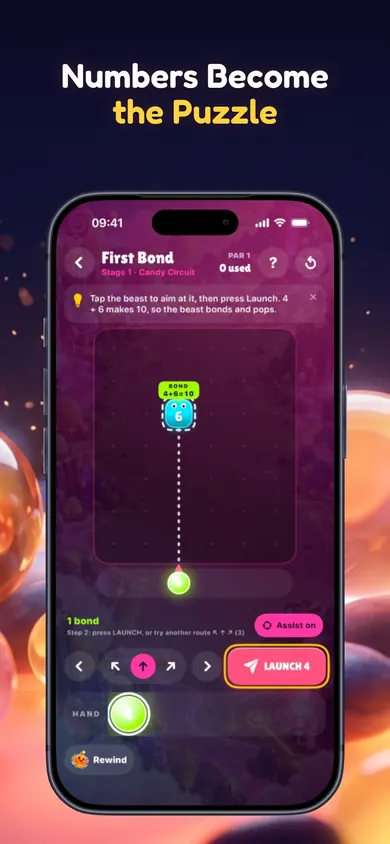 12
Stage 4, as a shot
1 With aim assist on, the exact sum (BOND 4+6=10) appears before you launch, so a child can check the fact first. 2 Nothing fires until they press Launch. Turn assist off later for pure planning.
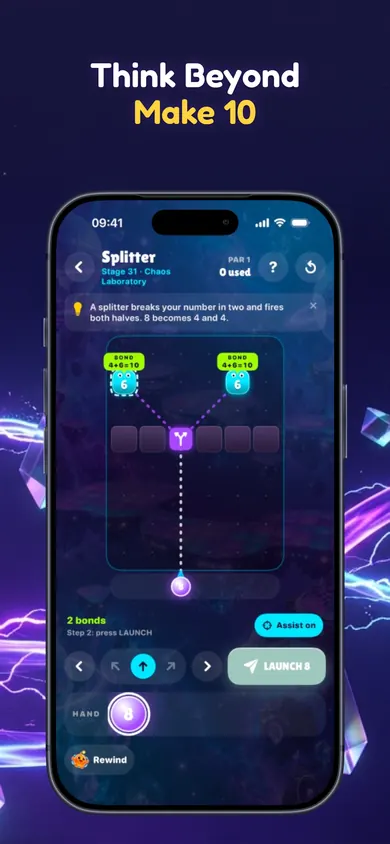 3
Beyond ten, later
3 Splitters halve a number into two shots, and later beasts need 15 or 20. Save these worlds for when stage 5 feels easy.
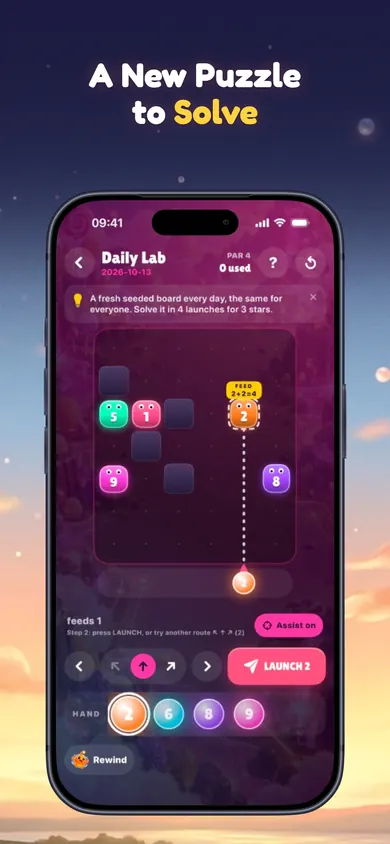 4
The five-minute habit
4 The Daily Lab is one fresh puzzle a day, made on the device and checked as solvable before you see it. That fits the "five minutes, stop while it's fun" rule.
Every stage is solver-checked, so a stuck child is never facing an impossible board.
Honest limits
- It practises; it does not diagnose. The app won't tell you which stage your child is at. Use the checklist above for that.
- Some reading helps. Tips and stage text are written words, so pre-readers will need you nearby for the first stages.
- Help tools cost stars. Bloop rewinds, Zappo nudges a number by one, Nimbus shows a winning move. Any tool caps a stage at two stars. We designed it that way so stars mean "I planned it myself", but some children find capped stars frustrating, so tell them in advance.
One design decision we stand behind: nothing is random. Every stage is handcrafted and checked by a solver, so a wrong answer is always a thinking problem, never bad luck.
The app is a practice partner; you are still the teacher.

Make ten. Carry the rest.
Start on your iPhone with Candy Circuit and today's Daily Lab. No ads, no purchases.
More from Pocket Puzzle Arcade
- Winter break math practice for first gradeWinter break math practice for first grade: enter your break dates, get a day-by-day plan of 10-minute make-ten games, mostly screen-free.
- Idle game upgrade payback calculatorWhich idle game upgrade should you buy next? Compare cost and income, see payback time and the best next buy, then test yourself in a 3-round quiz.
- When to prestige in idle gamesWhen should you prestige in an idle game? Slide in the bonus a reset would give you, see NOW vs AFTER, and get a clear reset-or-push verdict.
- Games like Gravity GuyGravity Guy left the App Store in 2018. Play a 20-second gravity-flip demo, then compare three current one-tap runners from their App Store listings.