You don't need dates. You need order.
A 5-round history quiz for curious families. Tap the older event; see the real gap.
Dear fellow history detective,
Most of us learned history as a list of dates, and most of us forgot them. What sticks is order: what came before what, and how far apart. That is why the quiz above hides the dates until you choose. Then it shows the real gap on a bar, because "a long time ago" can mean 1 year or 77 million.
What is a "which came first" history quiz?
A which-came-first history quiz shows two events and asks you to pick the older one. It trains a sense of chronology instead of memorising dates. Good versions only use events with settled dates, show the answer's source, and tell you how big the gap really was.
Our eight pairs all come from museum, university or peer-reviewed sources, linked below. Where an exact year is uncertain, we say "about" or use the traditional date and label it.
Order first, dates second: that is how chronology sticks.
The answers, with sources
| Pair | First | Gap |
|---|---|---|
| Teaching at Oxford vs Tenochtitlan founded | Oxford | about 250 years |
| Sharks vs trees | Sharks | about 15 million years |
| Great Pyramid vs last woolly mammoths | Pyramid | roughly 500 years |
| Rosetta Stone vs Cleopatra's birth | Rosetta Stone | 127 years |
| Pompeii buried vs Colosseum opens | Pompeii | 1 year |
| Stegosaurus vs T. rex | Stegosaurus | 77+ million years |
| Norse in Newfoundland vs Columbus | Norse | 471 years |
| Ötzi the Iceman vs Great Pyramid | Ötzi | about 700 years |
Sources: University of Oxford (teaching by 1096) and World History Encyclopedia (Tenochtitlan's traditional founding date, 1345); Live Science (shark-like fishes about 400 million years ago, first trees 380–390 million); World History Encyclopedia (Great Pyramid, about 2560 BC) and Stockholm University, 2024 (Wrangel Island mammoths extinct about 4,000 years ago); Rosetta Stone, 196 BC and Cleopatra VII, 69–30 BC; Pompeii, AD 79 and Colosseum, AD 80; Natural History Museum on Stegosaurus (152–145 million years ago) and Tyrannosaurus (68–66 million); NPR, 2021 (Norse wood cut in AD 1021); South Tyrol Museum of Archaeology (Ötzi, over 5,300 years ago).
The one that surprises everyone
Cleopatra was born around 69 BC. The Great Pyramid was finished around 2560 BC, about 2,490 years earlier. The Apollo 11 Moon landing was in 1969, about 1,998 years after Cleopatra died in 30 BC (NASA's Apollo 11 page). So Cleopatra lived closer in time to the Moon landing than to the building of the Great Pyramid.
The same trick works for dinosaurs: the last Stegosaurus lived around 145 million years ago and the first Tyrannosaurus around 68 million, so T. rex lived closer to us than to Stegosaurus.
"Ancient" is not one era. It is thousands of years deep.
Mini-story: holiday table round
Picture a family dinner over winter break. Someone passes a phone around and reads two cards out loud. Grandpa is sure the Colosseum came first; a ten-year-old says Pompeii. The cards flip, the gap reads "1 year", and the argument turns into a question: was the Colosseum being built while Vesuvius erupted? That question is the point.
The best round ends with a new question, not a score.
Who should pick something else
- Students cramming exact dates for a test: use flashcards. This quiz trains order and scale, not recall.
- Very young children: PastRush is rated 9+, and many cases ask you to weigh sources in writing.
- Anyone after a trivia app with thousands of questions: PastRush has 12 investigations and 245 globe stories, built for depth, not volume.
Questions families ask
Why are some dates "about"?
Ancient and prehistoric dates come from evidence like radiocarbon dating, tree rings and written records, which give ranges. We use "about" when the source does.
How do you count years between BC and AD?
Add the two numbers and subtract one, because there is no year zero. From 30 BC to AD 1969 is 30 + 1969 - 1 = 1,998 years.
Is there a which-came-first game in PastRush?
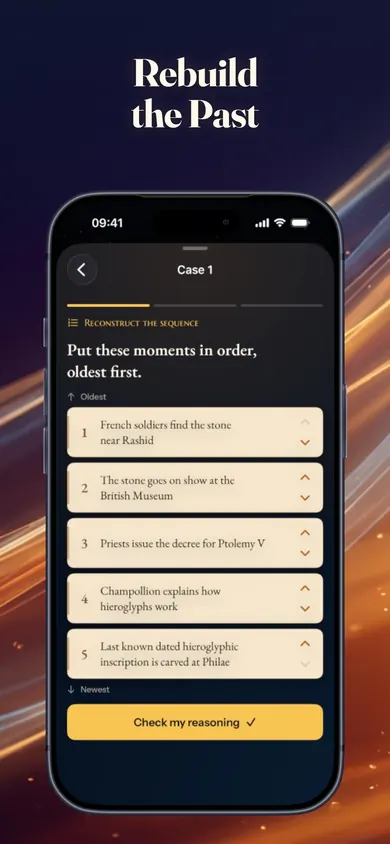
Yes. Which Came First? is a mode in PastRush 1.1: tap the older of two events. Dates that historians still debate are left out, so every round has one right answer.
Does PastRush work offline?
Cases, the Notebook, stories, the Album and ancient-Earth maps work offline. The satellite map, Dive's satellite views, Where in the World? and nearby places need internet.
Is PastRush free?
Yes, with six free investigations. Founder Lifetime is an optional one-time purchase that adds cases 7 to 12 and more; there is no subscription and no ads.
Honest limits
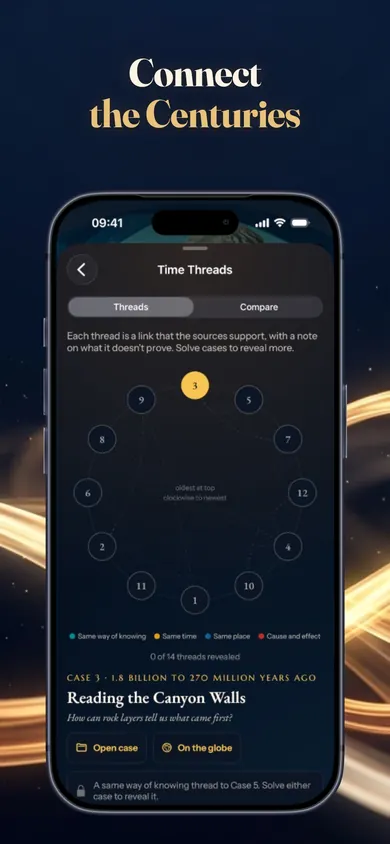
Our quiz has eight pairs; you will see repeats after a few plays. In PastRush, story pictures are AI-assisted illustrations and are always labelled as illustrations, never presented as photographs. Six of the twelve investigations need the Founder Lifetime purchase. Our design decision: every exhibit carries a label (made at the time, written later, scientific finding or modern reconstruction), so a player always knows what kind of evidence they are looking at.
Weigh the evidence. Then decide.
— the PastRush studio

Make it a habit with PastRush. One case at a time.
A Daily Evidence Check, 12 investigations and a 3D globe. No account, no ads, no tracking.
- Years between BC and AD calculatorCount the years between a BC date and an AD date without the off-by-one error. Free calculator, worked example and a true-scale time bar.
- Primary vs secondary sources examplesPrimary vs secondary sources, with 12 real examples, a 3-tap quiz and straight answers to the questions students and parents ask most.
- Weather quiz for kidsA weather quiz for kids: frost, gales and thunder in six quick taps, every answer checked against the National Weather Service. Then play the storm.
- Idle game upgrade payback calculatorWhich idle game upgrade should you buy next? Compare cost and income, see payback time and the best next buy, then test yourself in a 3-round quiz.