What are the best history games for middle school?
For US history taught through role-play, Mission US is the strongest free pick. For civics and government, choose iCivics. For practice reading real documents like a historian, use Reading Like a Historian. For a phone-sized detective game about evidence, try PastRush. All four cost nothing to start.
We wrote this for parents whose middle schooler already has an iPhone and asks for "something to play". The goal is a game that is honestly fun and also builds the habits teachers grade: putting events in order, weighing sources and saying what the evidence can and cannot prove.
The best history game is the one that makes a kid ask "how do we know?"
History games compared, side by side
| Mission US | iCivics | Reading Like a Historian | PastRush (ours) | |
|---|---|---|---|---|
| Made by | The WNET Group | iCivics, founded by Justice Sandra Day O'Connor | Digital Inquiry Group | Honest Little Apps |
| What you do | Role-play a young person in a US history era | Play roles such as lawyer or presidential candidate | Read primary documents around one question | Solve case files built from labelled exhibits |
| Topics | 8 missions, from 1500 to the Civil Rights era | Civics, rights and government | US and world history lessons | Rosetta Stone, Pompeii, Ötzi, Vinland and more |
| Grades | 5–8 per its site | Middle school classrooms | Mixed reading levels | App Store age 9+ |
| Device | Browser; some missions as iPad apps | Browser | Browser, printable | iPhone app |
| Cost | Free | Free with registration | Free with an account | Free; optional one-time Founder Lifetime |
| Is it a game? | Yes | Yes | No, lessons | Yes |
Sources: mission-us.org lists eight missions "developed for use by middle school students" in grades 5–8, and the US Institute of Education Sciences calls the games "available at no cost". iCivics describes its game roles; Wikipedia notes materials are free to registered users. The Digital Inquiry Group offers free lessons with an account. All read November 3, 2026. Swipe the table sideways on a phone.
Two browser classics, one document library, one phone game. Pick by device and topic.
How PastRush works in 3 steps
- Open a case file. Six investigations are free for everyone: the Rosetta Stone, Pompeii, the rock layers of the Grand Canyon, Ötzi the Iceman, continental drift and the Norse in Vinland.
- Read the exhibit labels. Every exhibit is marked: made at the time, written later, scientific finding or modern reconstruction. That is the label you scratched above.
- Investigate five ways. Rebuild a chronology with BC and AD handled correctly, compare sources, link cause to consequence, match time and place, then sort claims into "supported" and "going too far". Every answer explains why and links to its source.
Those five tasks line up with the four reading strategies the Digital Inquiry Group teaches in Reading Like a Historian: sourcing, contextualizing, corroborating and close reading.
Same skills as a document-based question, in a case your kid actually wants to close.
Honest limits
- It is not a US history curriculum. There is no American Revolution or Civil Rights case. The cases cover ancient writing, archaeology, deep time and early exploration.
- Half the cases cost money. Six more cases (the Chicxulub impact, the Black Death, printing, Stonehenge, the Antikythera mechanism and the last mammoths) come with Founder Lifetime, a one-time purchase with no subscription.
- Some features need internet. The satellite map, Dive's satellite views and Where in the World? need a connection. Cases, the Notebook, stories and the Album work offline.
- Story pictures are illustrations. They are AI-assisted and marked as illustrations, never shown as photos of real objects.
The design decision we care most about: no ads and no tracking. Cards in the Album are earned by playing, never sold.
Small, careful and incomplete on purpose: six free cases done properly.
Who should pick something else
- Families following a US history unit. Mission US matches the classic grade 5–8 topics better.
- Students studying government. iCivics is built for civics.
- Kids without an iPhone. PastRush is an iPhone app; the other three run in a browser, which works on a Chromebook.
- Anyone who wants pure speed. PastRush asks for reading and reasoning. If your child wants fast reflex play, this will feel slow.
What it looks like on iPhone
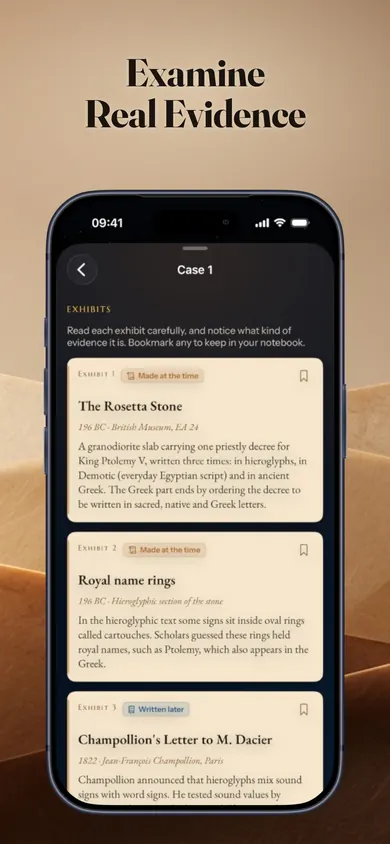
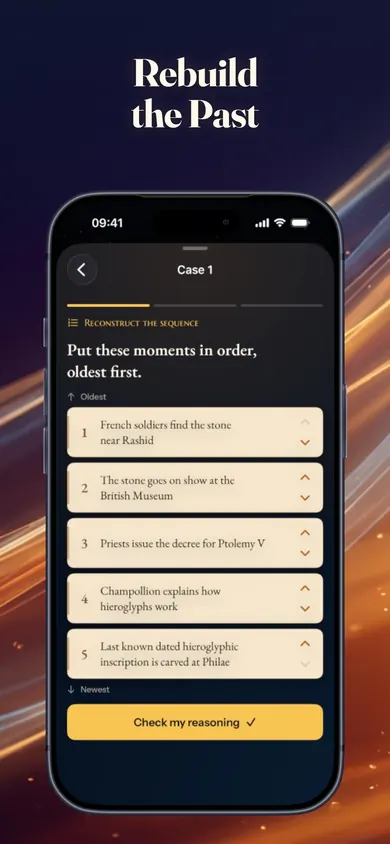
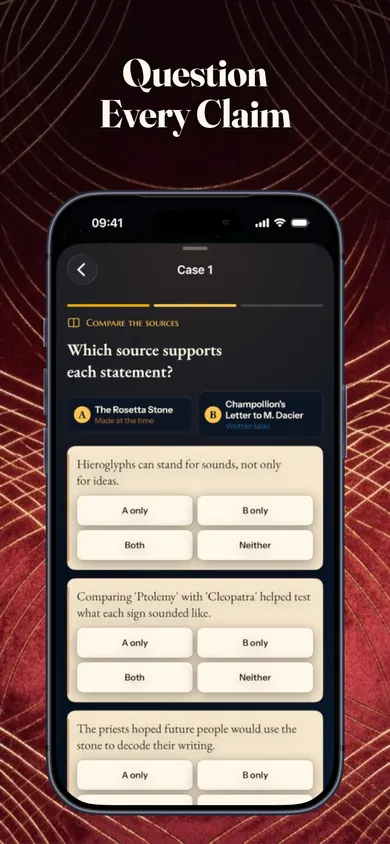
Parchment cards, a navy desk and one question: what does this exhibit prove?
Questions parents ask
Are there free history games for middle school?
Is PastRush free?
Does PastRush have ads or need an account?
Can a class use PastRush on shared devices?
Does it work without Wi-Fi?
What age is PastRush for?
The exhibit you just scratched
Case 1, worked through
Those dates come from Live Science's history of the decipherment, which puts the announcement on September 27, 1822. From 196 BC to AD 1822 is 2,017 years, because there is no year zero. The letter is precious evidence about how hieroglyphs were cracked, and it is still a source "written later" about the stone. Spotting that difference is the core skill in every PastRush case.
Made at the time, or written later? Ask it of every source, and history gets sharper.
Be a history detective.
Start on your iPhone with the Rosetta Stone, then work through all six free cases.
More from Pocket Puzzle Arcade
- Famous inventions timeline quizA famous inventions timeline quiz: drag six inventions into order, then see the real gaps on a true-scale time bar. Every date sourced. Free, no sign-up.
- Primary vs secondary sources examplesPrimary vs secondary sources, with 12 real examples, a 3-tap quiz and straight answers to the questions students and parents ask most.
- Which came first history quizA which-came-first history quiz: tap the older of two events, see the real gap on a time bar, and find out what surprised you. Sources for every date.
- Years between BC and AD calculatorCount the years between a BC date and an AD date without the off-by-one error. Free calculator, worked example and a true-scale time bar.