Make ten. Carry the rest.
For parents of first graders: tap how your child solves 8 + 6 and get tonight's next step.
By the Honest Little Apps studio, makers of Number Beasts · Updated November 2026
What should addition within 20 practice look like at home?
Short, strategy-first and a little playful: five to ten minutes on one strategy your child is ready for, not a page of mixed sums. In the US, the Common Core standard for first grade, 1.OA.C.6, asks children to add and subtract within 20 using strategies such as counting on, making ten (8 + 6 = 8 + 2 + 4 = 10 + 4 = 14) and known sums like doubles.
The question at the top sorts those strategies into a ladder. Find your child's rung, practise the next one up, and ask the 8 + 6 question again next week.
- 1Counting allStarts at 1 and counts every object or finger.
- 2Counting onStarts at the bigger number and counts up.
- 3Making tenSplits a number to fill 10, then adds the rest.
- 4Known factsRecalls sums, and links them to subtraction (8 + 6 = 14, so 14 − 8 = 6).
Find the rung, practise one rung up, ask again next week.
Is finger counting a problem in first grade?
Tonight's practice set: 8 questions
Pick a rung in the chat above, or use the buttons here. Each set is new every time, stays within 20, and shows the strategy line under each answer.
Rung 2 → practise making ten
Who Number Beasts is not for
- Children who cannot yet count to 10 with confidence. Start with objects and counting games first.
- Families who want a full curriculum with lessons and progress reports. Number Beasts is a puzzle game that practises one big idea: making ten and carrying the rest.
- Kids who only want fast drills. The main mode is turn-based planning, though an arcade mode is there for speed.
How it works: the make-ten idea as a game
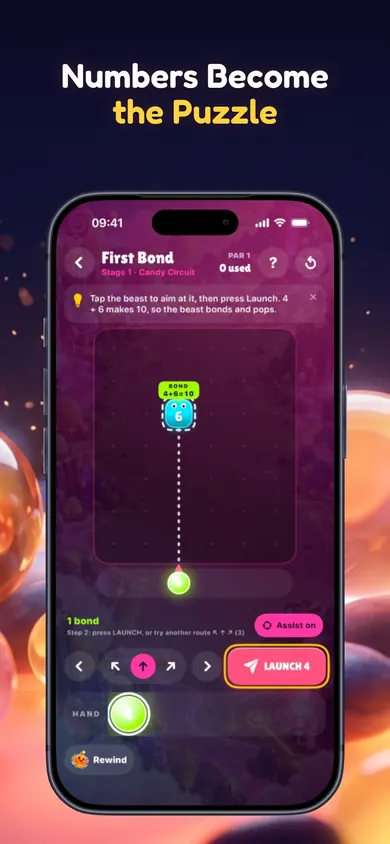
- Bond. Launch a number at a beast. Make exactly 10 and it pops.
- Feed. Fall short and the beast grows; now it needs a smaller number.
- Bridge. Overshoot and the beast still pops, while the leftover keeps flying. The App Store listing's example: launch a 7 into a 5 and a 2 carries on. That is 5 + 7 = 10 + 2, the making-ten strategy, played.

Honest limits
Our practice sets cover addition only, plus one subtraction link on rung 4. The game leans on making 10; beasts that need 15 or 20 only arrive in the third world, Chaos Laboratory. Nothing here replaces your child's teacher, who will know which strategy their class uses.
One design decision we stand by: no ads, no accounts, no tracking and no in-app purchases, per the App Store listing. Everything stays on the device and works offline.
Addition within 20: parent FAQ
What does addition within 20 mean?
How long should addition practice be for a first grader?
Which addition strategy should I teach first?
Is it bad if my child counts on fingers?
Does Number Beasts have ads or in-app purchases?
Make it a nightly five minutes
Print tonight's set, then let the beasts take over tomorrow. Make it a habit with Number Beasts: 45 handcrafted stages and a fresh Daily Lab every day.
- Kindergarten math games without adsKindergarten math games without ads: flip three myths about free kids' apps, learn a 60-second ad check, and try a make-ten puzzle with no ads or shop.
- Number bonds to 20 gamesNumber bonds to 20 games for second grade: play a make-20 beast demo, collect all 9 pairs, and get plain answers to the questions parents ask.
- How to teach number bonds to 10Number bonds to 10 not sticking? Tick a 5-step checklist to find where to start, try no-prep games, and play a make-10 demo with your child.
- Winter break math practice for first gradeWinter break math practice for first grade: enter your break dates, get a day-by-day plan of 10-minute make-ten games, mostly screen-free.