What did your launches show?
Every bond above lights one of the nine pairs that make 20 with a one-digit number. Collect them all and your child has said every "teen plus something" fact out loud. The yellow and orange dots are doing the real teaching: 12 + 8 is one full ten, then 2 and 8 making the second ten.
0 of 9 pairs found. Launches 0 · Bonds 0 · Feeds 0 · Bridges 0
Play a few launches above and this note will suggest what to practise next.
BONDFEEDBRIDGE
Those three words are the rules of Number Beasts, cut down for this page. Make exactly 20 and the beast pops (bond). Fall short and it grows, so now it needs a smaller number (feed). Overshoot and it pops, but the leftover spills back in as a brand-new beast (bridge). In the app the target is usually 10; in its third world, Chaos Laboratory, some beasts need 15 or 20.
A bond to 20 is a bond to 10 wearing a coat: 13 + 7 is 10, plus 3 + 7.
Number bonds to 20: the questions parents ask
We grouped the answers in the order they usually come up: before your child starts, while you are playing, and after a week of short games.
Before you play
What are number bonds to 20?
What grade learns number bonds to 20?
Should my child know number bonds to 10 first?
While you play
What are good number bonds to 20 games with no prep?
How do number bonds to 10 help with bonds to 20?
Are timed math fact games a good idea?
My child still counts on fingers. Is that a problem?
After a week
How long should number bond practice last?
How do I know my child is fluent with facts to 20?
Does Number Beasts teach number bonds to 20?
Is Number Beasts free and safe for kids?
Ten first, then twenty, then speed. Skipping a step is what makes facts feel hard.
Which number bonds to 20 game fits your evening?
Here are three ways to practise, side by side. Two are free and screen-free; one is our app. Pick by how much time and energy you have tonight.
| Game | You need | What it practises | Best for |
|---|---|---|---|
| Coin Frames | 20 coins, two egg boxes cut to ten cups | Seeing 20 as two tens; the missing part | Children still counting every object |
| Make-20 Snap | 18 paper slips: 1–9 and 11–19 | Fast recall of the nine teen pairs | Two players who like a race |
| Number Beasts (ours) | An iPhone; free, no ads | Make-ten planning, carrying leftovers, 15 and 20 beasts | A child who enjoys puzzles and wants to do it alone |
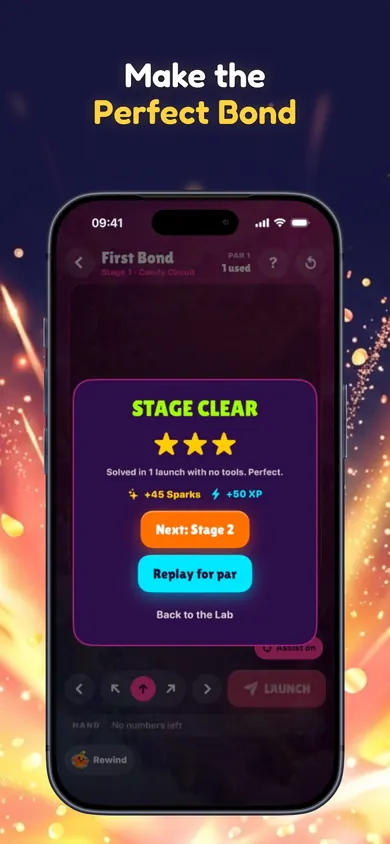
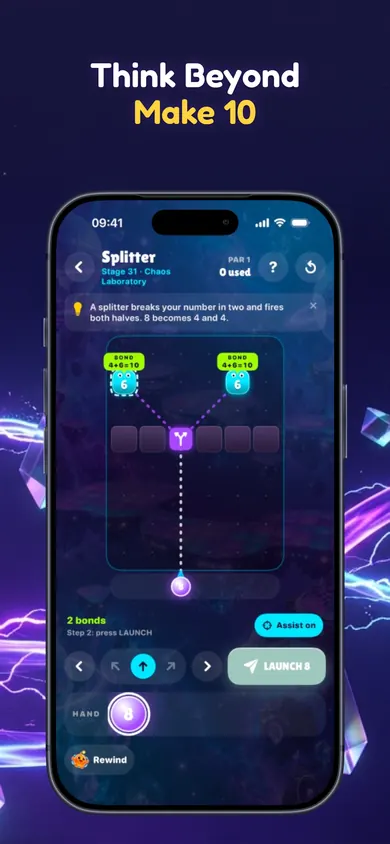
The app's Daily Lab adds a fresh puzzle every day, made on the device and checked as solvable before your child sees it. Every one of the 45 handcrafted stages is checked by a solver, so none is unwinnable, and each has a par to beat.
Screen-free games build the facts; a puzzle game gives them a reason to be used.
Honest limits
- It is mostly a make-10 game. Bonds to 20 appear through leftovers and in the third world. If your child only needs the nine teen pairs drilled, Make-20 Snap is faster.
- It is not timed in Bond Lab. The puzzles are turn-based. That is calm, but it does not build speed. The real-time arcade mode is the faster option inside the app.
- It is iPhone only. No Android version is listed.
- Aim assist can do the adding. With it on, the path and the sum (BOND 4+6=10) show before launch. For practice, switch it off so your child says the sum first.
One design decision we stand by: nothing in the game is random. Every stage is a small plan of which number, which order and which angle, so a child who thinks it through always wins. Children who need a teacher's structured intervention, or who are not yet secure with numbers to 10, should start with objects and an adult rather than any app.
Use the app as the treat after the coins, not instead of them.

Make the perfect bond. Then carry the rest.
45 solver-checked stages, a Daily Lab and a Beast Workshop for building your own boards. No ads, no accounts, no in-app purchases. Open Number Beasts in the App Store.
More from Pocket Puzzle Arcade
- How to teach number bonds to 10Number bonds to 10 not sticking? Tick a 5-step checklist to find where to start, try no-prep games, and play a make-10 demo with your child.
- Winter break math practice for first gradeWinter break math practice for first grade: enter your break dates, get a day-by-day plan of 10-minute make-ten games, mostly screen-free.
- Primary vs secondary sources examplesPrimary vs secondary sources, with 12 real examples, a 3-tap quiz and straight answers to the questions students and parents ask most.
- Idle games with offline progressIdle games with offline progress, explained: a live away-earnings counter, a check-in planner for offline caps, and one idle tycoon that keeps printing.
Sources, checked November 2026: Common Core grade 2 operations standards, grade 1 standards, National curriculum in England: mathematics, IES practice guide, Assisting Students Struggling with Mathematics (2021).